Summary
Your knee symptoms are a communication system — clicking, swelling, locking, stiffness, and buckling each point to different underlying structures and conditions. Identifying the symptom pattern is the first step toward an accurate diagnosis and effective treatment. MAPS Centers for Pain Control in Chicago offers comprehensive, non-surgical knee pain care tailored to what your body is actually telling you.
Introduction
Your knee doesn’t just hurt — it communicates.
A click when you bend down. A dull ache after sitting for an hour. A sharp stab when you take a step on the stairs. A terrifying buckle mid-stride that nearly puts you on the floor. These aren’t random malfunctions. Each symptom is a specific signal from a specific structure inside one of the most mechanically complex joints in the human body.
The problem is that most people either ignore these signals until the pain becomes unbearable, or they assume every knee problem is “just arthritis” and nothing can be done. Neither is true.
This guide decodes the most common knee pain symptoms — what they feel like, what they likely mean anatomically, and what modern, non-surgical treatments can do about them. Because understanding your symptoms isn’t just helpful — it’s the foundation of getting the right care.
Anatomy in 60 Seconds: Why the Knee Is So Vulnerable
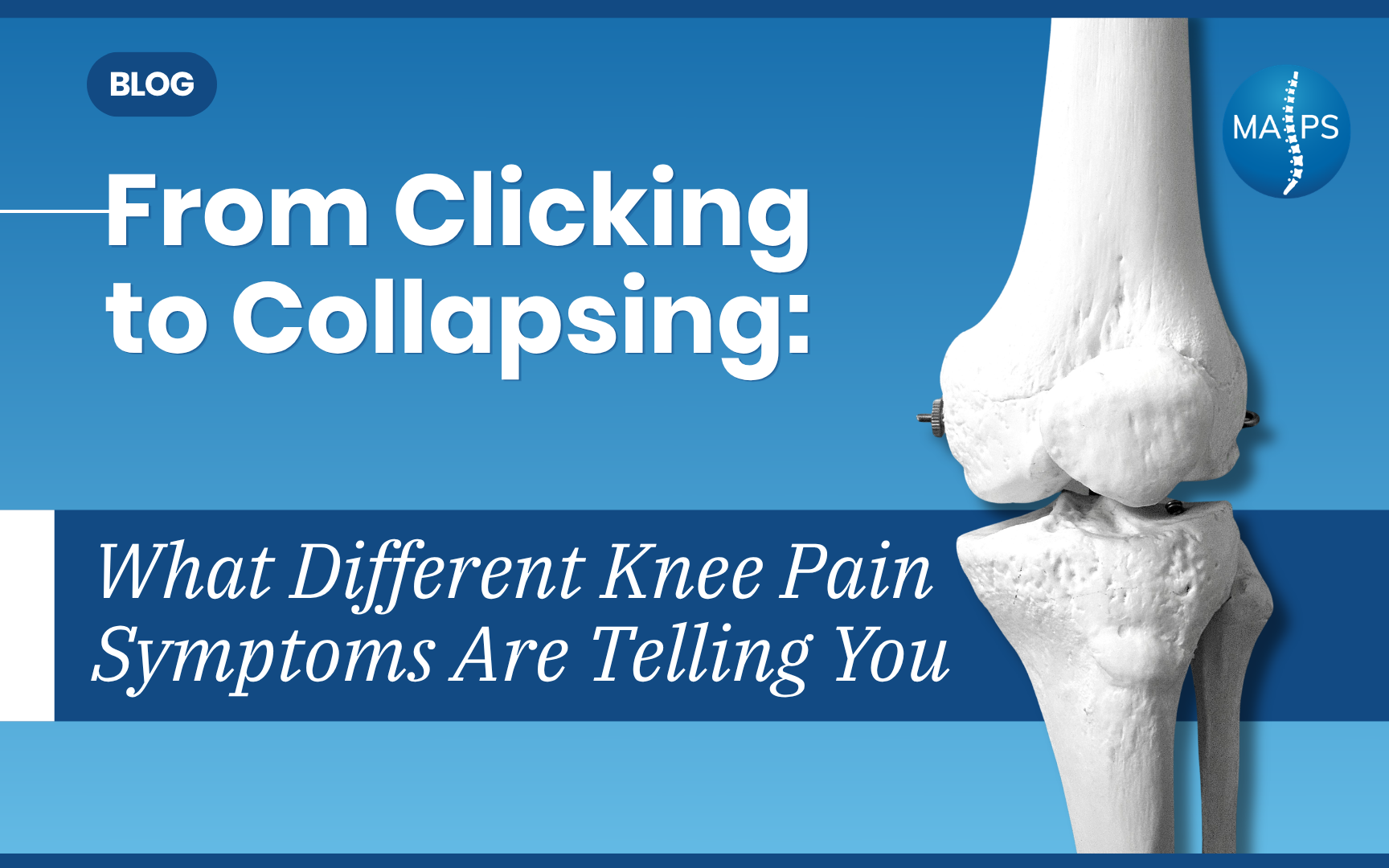
Before decoding symptoms, it helps to understand why the knee breaks down so frequently. The knee is not a simple hinge. It’s a tri-compartmental joint involving the femur (thigh bone), tibia (shin bone), and patella (kneecap), supported by:
- Two menisci — cartilage cushions that absorb shock and stabilize the joint
- Four major ligaments — ACL, PCL, MCL, and LCL — that control movement and prevent instability
- Articular cartilage — the smooth surface lining that allows bones to glide without friction
- Bursae — fluid-filled sacs that reduce friction between tissues
- The quadriceps and hamstring muscle groups — which provide dynamic support and power
Damage, degeneration, or dysfunction in any one of these structures produces a distinct symptom signature. That’s exactly what we’re going to break down.
Symptom 1: Clicking, Popping, or Crunching
What It Feels Like
A clicking or popping sound when bending, straightening, or walking. Sometimes audible to others. Sometimes painless; sometimes accompanied by a sharp catch.
What It Often Means
- Benign crepitus — The most common cause. Gas bubbles escaping from synovial fluid in the joint produce harmless popping. No pain, no problem.
- Meniscus tear — A torn meniscus can catch and pop as the knee moves. This type of clicking is often accompanied by pain, swelling, or a feeling that something is “catching” inside the joint.
- Patellofemoral syndrome — When the kneecap doesn’t track smoothly over the femoral groove, it can produce grinding or crunching (called crepitus) during stair climbing or squatting.
- Loose body in the joint — Fragments of bone or cartilage floating in the joint space can cause intermittent clicking and locking.
- Ligament snapping — Tight or damaged ligaments can snap over bony structures, producing an audible pop.
When to act: Clicking with pain, swelling, or limited motion warrants evaluation. Painless clicking alone is typically harmless.
Symptom 2: Swelling
What It Feels Like
Visible puffiness around the knee, sometimes developing over hours, sometimes over days. The joint may feel warm, tight, or heavy. Bending fully may be impossible.
What It Often Means
- Acute joint effusion — Rapid swelling (within 2 hours of an incident) often signals significant structural damage — a ligament tear, meniscus injury, or fracture — and should be evaluated urgently.
- Osteoarthritis — Chronic, low-grade swelling that worsens with activity and improves with rest is a hallmark of arthritic inflammation.
- Bursitis — Inflammation of the bursae (most commonly the prepatellar bursa at the front of the kneecap) produces localized swelling that can look dramatic but is often treatable.
- Gout or pseudogout — Crystal deposits in the joint cause sudden, intense swelling and redness — sometimes mistaken for infection.
- Infection (septic arthritis) — Swelling with fever, redness, and warmth requires emergency medical attention.
Swelling is the knee’s universal distress signal — but what’s driving it determines what needs to happen next. Learn more about the range of underlying causes in our guide to Common Causes of Knee Pain and How to Treat Them.
Symptom 3: Stiffness
What It Feels Like
Difficulty bending or straightening the knee fully. Worst first thing in the morning or after prolonged sitting. Improves with gentle movement but worsens again with overactivity.
What It Often Means
- Osteoarthritis — Morning stiffness lasting under 30 minutes that loosens with movement is a classic OA pattern. Joint space narrowing and cartilage loss reduce fluid range of motion.
- Rheumatoid arthritis — Morning stiffness lasting over an hour, often bilateral, with systemic symptoms (fatigue, hand involvement) suggests inflammatory arthritis.
- Post-surgical or post-injury scarring — Scar tissue (arthrofibrosis) can develop after injury or surgery and dramatically limit range of motion.
- Baker’s cyst — A fluid-filled sac at the back of the knee can create a sensation of tightness and limit full flexion.
- Iliotibial (IT) band tightness — Particularly in runners, a tight IT band creates lateral knee stiffness and pain.
Stiffness is one of the most common early warning signs of degenerative joint disease — and one of the most actionable, especially when addressed before significant cartilage loss occurs.
Symptom 4: Pain Going Up or Down Stairs
What It Feels Like
Sharp or aching pain at or around the kneecap specifically during stair climbing, descending, or squatting. Level walking may be fine; inclines are not.
What It Often Means
Stair-specific pain is almost always a patellofemoral problem. Going up or down stairs dramatically increases the compressive forces on the patellofemoral joint — up to seven times body weight — making this the movement that most reliably exposes cartilage damage, poor patellar tracking, or early arthritis in that compartment.
This symptom pattern has its own dedicated breakdown in our article Knee Pain When Going Up or Down Stairs: What It Means and How It’s Treated, which covers patellofemoral syndrome, chondromalacia patella, and treatment protocols in detail.
Symptom 5: Knee Locking
What It Feels Like
The knee suddenly refuses to fully straighten — or rarely, to bend. The blockage feels mechanical, like something is physically stuck. Forcing the motion causes pain.
What It Often Means
- Torn meniscus — A displaced meniscus tear is the most common cause of true mechanical locking. A flap of torn cartilage folds into the joint space and physically blocks movement.
- Loose body — Cartilage or bone fragments that migrate into the joint can wedge between joint surfaces.
- Pseudo-locking — Muscle spasm or severe pain can cause the knee to resist movement without a true mechanical block. This is more common with acute injury or severe arthritis flares.
True mechanical locking that doesn’t resolve on its own within a short period requires prompt medical evaluation — delay can worsen cartilage damage.
Symptom 6: Buckling or Giving Way
What It Feels Like
The knee suddenly collapses or gives out — without warning — during walking, pivoting, or descending stairs. May be accompanied by pain, or may happen before pain registers. Terrifying and potentially dangerous.
What It Often Means
- Ligament instability — Laxity or damage to the ACL, PCL, or collateral ligaments allows abnormal joint movement during weight-bearing.
- Severe cartilage or meniscus damage — Structural loss inside the joint can cause the knee to lose its mechanical integrity under load.
- Quadriceps weakness — The thigh muscles are the knee’s primary dynamic stabilizers. Weakness — from injury, disuse, or neurological causes — can cause buckling even without structural joint damage.
- Patellofemoral instability — The kneecap can subluxate (partially dislocate) during movement, producing a sudden give-way sensation.
- Neurological causes — Nerve dysfunction affecting the muscles controlling the knee can cause episodic collapse. This is one of the 3 Surprising Causes of Knee Pain You Might Overlook that often go undiagnosed.
Buckling is a safety issue as much as a pain issue. Falls from knee give-way can cause secondary injuries. Prompt evaluation is essential.
Symptom 7: Localized Pain — What the Location Tells You
Where exactly your knee hurts is as diagnostic as how it hurts.
- Front of the knee (anterior) — Patellofemoral syndrome, patellar tendinitis (“jumper’s knee”), or Osgood-Schlatter in adolescents
- Inner knee (medial) — Medial meniscus tear, MCL sprain, or medial compartment arthritis
- Outer knee (lateral) — IT band syndrome, lateral meniscus tear, or LCL injury
- Behind the knee (posterior) — Baker’s cyst, PCL injury, or hamstring tendinopathy
- Diffuse or all-around the knee — Advanced osteoarthritis, inflammatory arthritis, or post-surgical changes
Pain location narrows the diagnostic picture significantly and helps your provider order the right imaging and perform the most targeted physical examination.
Why Symptom Patterns — Not Just Pain — Drive Better Treatment
One of the most common frustrations patients bring to MAPS is having been told “you have arthritis” without any further exploration of which specific structures are involved, at what severity, or how their unique symptom pattern should shape treatment.
Knee pain treatment is not one-size-fits-all. A patient whose primary symptom is buckling due to quadriceps weakness needs a fundamentally different intervention than a patient whose clicking and medial pain points to a meniscus tear — even if both are labeled “knee arthritis” on a referral form.
This is why MAPS pain specialists begin every knee pain evaluation by listening carefully to the full symptom story. As Thomas Pontinen, MD, LCP-C, co-founder of MAPS Centers for Pain Control, puts it: “The norm for us is significantly changing someone’s life.” From there, the treatment pathway is built around the specific structures involved.
This is why MAPS pain specialists begin every knee pain evaluation by listening carefully to the full symptom story. From there, the treatment pathway is built around the specific structures involved.
Options range from precisely targeted Injection-Based Knee Pain Treatments for inflammation and joint degeneration, to Genicular Nerve Ablation for Knee Pain for patients with chronic arthritic pain that hasn’t responded to other approaches, to the full spectrum outlined in Knee Pain Treatments at a Glance: Non-Surgical Options.
Dr. Pontinen explains the appeal of these approaches plainly: “These injections are very simple. They’re well studied. They’re not bad for you. There’s very little side effect profiles with a lot of these injections. And really the worst case scenario is it doesn’t help much — but the flip side is it could provide very significant relief for months if not years.”
On regenerative options like PRP specifically, he adds: “You’re actually hoping to heal the tissue in a more permanent manner… the growth factors help the tissue heal and also recruit other healing cells from your body because they create signaling molecules that then improve your body’s own healing on a more long-term basis.”
For a comprehensive overview of what non-surgical care looks like at MAPS from first appointment through recovery, visit Knee Pain Treatment in Chicago – Non-Surgical & Innovative Solutions.
Frequently Asked Questions
Q: Is a clicking knee always a sign of damage? A: Not necessarily. Painless clicking or popping is usually harmless gas release from synovial fluid. Clicking paired with pain, swelling, or catching inside the joint is more likely to reflect structural damage and warrants evaluation.
Q: My knee swells after activity but feels fine in the morning. Is that arthritis? A: Activity-related swelling that resolves with rest is a common pattern in early to moderate osteoarthritis. However, it can also indicate meniscus damage or ligament stress. A clinical examination will clarify the source.
Q: Can buckling happen without a ligament tear? A: Yes. Quadriceps weakness is a very common cause of knee give-way without any ligament pathology. Neurological conditions and severe patellofemoral instability can also cause buckling without ligament damage.
Q: I have stiffness but no real pain. Should I still see a doctor? A: Yes. Stiffness without pain is often an early sign of cartilage degeneration or inflammatory arthritis. Addressing it early — before significant structural loss — typically leads to much better outcomes.
Q: How do I know if my knee pain needs surgery? A: The majority of knee pain conditions — including arthritis, meniscus irritation, and ligament instability — can be effectively managed without surgery using modern interventional and regenerative treatments. MAPS specializes in exhausting non-surgical options first and thoroughly, with excellent results for most patients.
Q: What’s the first step if I’m experiencing multiple symptoms? A: Schedule a comprehensive evaluation with a knee pain specialist who will assess your full symptom pattern, perform a physical examination, and order appropriate imaging. Treating without an accurate diagnosis leads to wasted time and money.
Q: Does MAPS treat knee pain from sports injuries? A: Yes. MAPS treats patients with both degenerative conditions (like osteoarthritis) and acute or chronic injuries from sports, accidents, and occupational stress.
Conclusion
Your knee has been trying to tell you something. Clicking, swelling, stiffness, locking, buckling, and location-specific pain are all part of a diagnostic language — one that, when properly interpreted, points directly toward the source of your problem and the most effective treatment.
The specialists at MAPS Centers for Pain Control in Chicago are trained to listen to that language carefully. With a thorough evaluation and a personalized, non-surgical approach, most patients can find meaningful relief — and get back to walking, climbing stairs, and moving through their lives without fear of what their knee will do next.
Dr. Pontinen captures it best: “Anyone who’s had chronic pain knows just how debilitating it is — how much it impacts you not only physically, but mentally and emotionally. You become a different person. You’re not just someone who survives every day despite being in all this pain. You’re someone who can actually seek out things you love again.”
Don’t wait for a collapse to take your symptoms seriously. Contact MAPS Centers for Pain Control today to schedule your knee evaluation with a Chicago pain specialist.