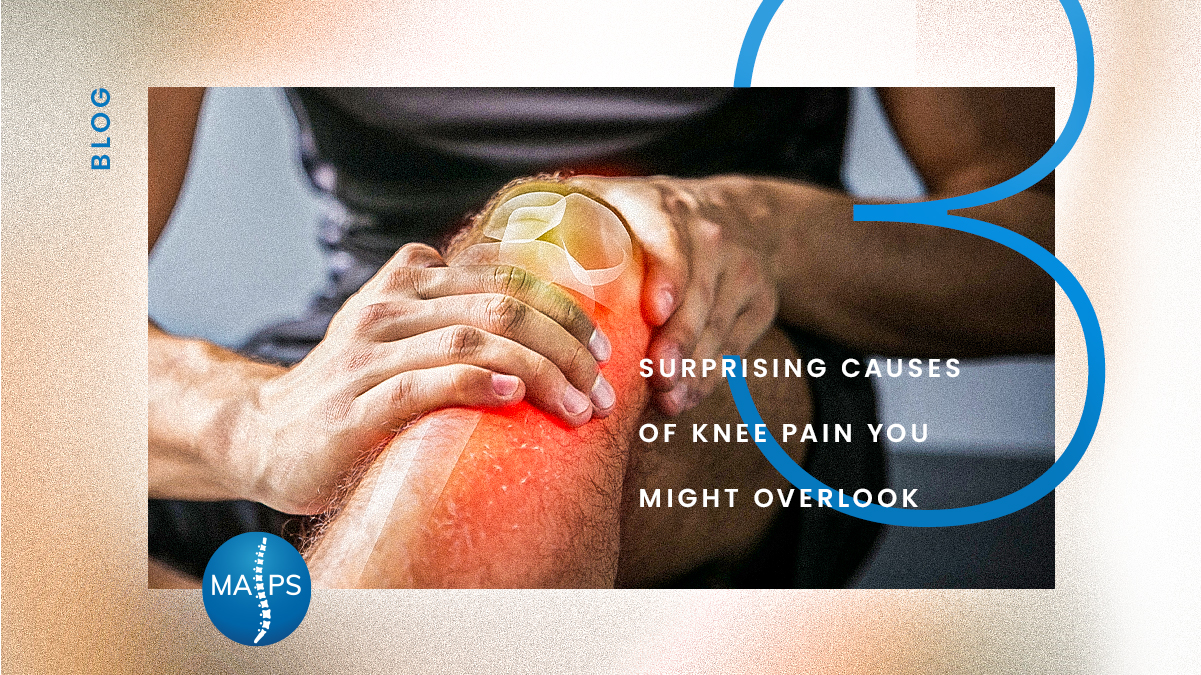
When people think about knee pain, they usually picture arthritis, a sports injury, or “just getting older.” And while those are certainly common, they’re not the whole story.
At MAPS Centers for Pain Control, knee pain is one of the most frequent reasons patients seek care—but many are surprised to learn that their pain isn’t always coming from obvious damage inside the knee joint itself. In fact, some of the most persistent knee pain cases stem from causes patients often overlook.
As Thomas Pontinen, MD, LCP-C explains:
“Knee pain, I would say along with back pain, is the most common thing we see at MAPS—mainly because it’s just so common.”
Understanding these less obvious triggers can help you take action sooner and prevent knee pain from becoming a long-term problem.
Summary
Not all knee pain comes from arthritis or major injuries. Nerve irritation, poor alignment or posture, and minor strains that never fully healed can all cause persistent knee pain. Identifying these overlooked triggers early allows for non-surgical treatments—such as targeted injections, bracing, regenerative therapy, or nerve-based treatments—to reduce pain and restore function.
1. Nerve Involvement (Even When the Knee Joint Looks “Fine”)
One of the most overlooked knee pain causes is nerve-related pain.
Not all knee pain is mechanical. In some cases, the sensory nerves around the knee become irritated, inflamed, or hypersensitive—sending pain signals even when X-rays or MRIs look relatively normal.
This type of pain often feels:
- Burning or electric
- Sharp or stabbing
- Constant, even at rest
- Worse at night or with light touch
Dr. Pontinen explains that knee pain usually falls into two categories:
“This could be chronic knee pain, so arthritis as the cartilage thins as you age… and the other type of pain would be more acute pain, usually due to an injury like tearing a ligament or a meniscus.”
When pain continues long after tissue should have healed, nerve signaling itself may be the problem.
2. Alignment, Posture, and How You Move
Another surprising cause of knee pain is how your body moves over time.
Knee pain doesn’t always start in the knee. Poor posture, muscle imbalances, hip weakness, foot mechanics, or spinal alignment issues can all shift stress unevenly through the knee joint.
Dr. Pontinen explains how this becomes a cycle:
“If there’s more degeneration on one side of the knee, the knee will start to bend inward or outward… and the more that it bends, the more pressure is put on the side that’s already thinning.”
Over time:
- Minor imbalance leads to uneven joint stress
- Uneven stress accelerates degeneration
- Pain alters gait
- Altered gait worsens pain and instability
Why This Matters
Alignment-related knee pain often worsens gradually, making it easy to dismiss until it significantly limits walking or confidence.
3. Minor Strains That Never Fully Healed
Not every knee injury is dramatic.
Many patients remember a small twist, awkward step, or soreness that “never quite went away.” Over time, lingering inflammation or micro-damage can evolve into chronic pain.
Dr. Pontinen explains:
“Sometimes that healing doesn’t complete itself, and the tissue continues to cause pain.”
Left untreated, these minor injuries can contribute to cartilage breakdown, joint irritation, and nerve sensitization.
Treatment Options for Knee Pain at MAPS Centers for Pain Control
When knee pain becomes persistent, treatment should be tailored to the true source of pain—whether it’s joint degeneration, inflammation, nerve involvement, or a combination of factors. At MAPS Centers for Pain Control, the focus is on non-surgical, evidence-based treatments designed to relieve pain while preserving the knee joint whenever possible.
Genicular Nerve Ablation
Genicular nerve ablation is an advanced option for patients with chronic knee pain—especially when pain is driven by nerve signaling rather than joint damage alone.
This procedure uses radiofrequency energy (heat) to disable the genicular nerves around the knee, preventing them from sending pain signals to the brain. The knee joint remains intact; only pain transmission is interrupted.
Genicular nerve ablation is commonly used for:
- Chronic knee arthritis pain
- Persistent pain after knee surgery or knee replacement
- Patients who are not surgical candidates or want to delay surgery
Pain relief often lasts 6–12 months or longer, and the procedure can be repeated if needed.
Injection-Based Therapy for Knee Pain
Many patients respond positively to injection-based treatments, which offer rapid pain relief while remaining non-surgical. These therapies can also help stimulate the body’s own healing process.
Hyaluronic Acid Injections
Hyaluronic acid is a naturally occurring lubricant in the body. When injected into the knee, it:
- Improves joint lubrication
- Reduces friction and stiffness
- Relieves arthritis-related pain
- Encourages natural synovial fluid production
Growth Factor Injections
Growth factor therapies harness the body’s natural ability to heal itself. These injections:
- Support tissue repair
- Promote longer-term healing rather than short-term masking
- Can be used for both acute injuries and chronic knee conditions
Steroidal-Based Injections
Steroid injections are used for rapid inflammation control, helping to:
- Reduce swelling
- Calm irritated tissue
- Improve mobility during flare-ups
While steroids don’t heal tissue, they can provide meaningful relief when inflammation is the primary driver of pain.
Supportive Therapies: Bracing and Stability
Bracing plays an important role for many patients.
Dr. Pontinen explains:
“A knee brace can help prevent worsening alignment and offload pressure from the damaged side of the joint. It also gives people confidence when walking.”
Braces can:
- Improve alignment
- Reduce joint stress
- Increase stability
- Decrease pain through compression and sensory input
When Knee Pain Becomes Chronic
If knee pain lasts more than a few weeks—or begins affecting walking, sleep, or confidence—it’s time for evaluation.
Dr. Pontinen emphasizes:
“There are many, many treatment options now that are not just pushing surgery or knee replacement.”
For many patients, early non-surgical intervention prevents progression and restores quality of life.
Frequently Asked Questions
1. Can knee pain really come from nerves?
Yes. Irritated or sensitized nerves can cause knee pain even when joint damage is minimal.
2. How do I know if my knee pain is nerve-related?
Burning, electric, or constant pain—especially when imaging looks normal—may suggest nerve involvement.
3. Should I wait before seeing a specialist?
If knee pain lasts more than a few weeks or keeps returning, early evaluation can prevent worsening damage.
4. Are injections safe for knee pain?
Yes. Many injections used at MAPS are well studied with minimal side effects when performed appropriately.
5. Do braces really help knee pain?
For many patients, braces improve alignment, reduce joint stress, and increase confidence while walking.
6. Will I need surgery for chronic knee pain?
Not necessarily. Many patients achieve significant relief with non-surgical treatments and never require surgery.
When to Take the Next Step
If your knee pain:
Has lingered longer than expected
Keeps coming back
Feels sharp, burning, or unstable
Limits your daily activities
…it may be time to explore non-surgical options.
As Dr. Pontinen puts it:
“You don’t have to let pain define you as a human being anymore.”
Schedule a consultation with MAPS Centers for Pain Control to explore personalized, non-surgical knee pain solutions.