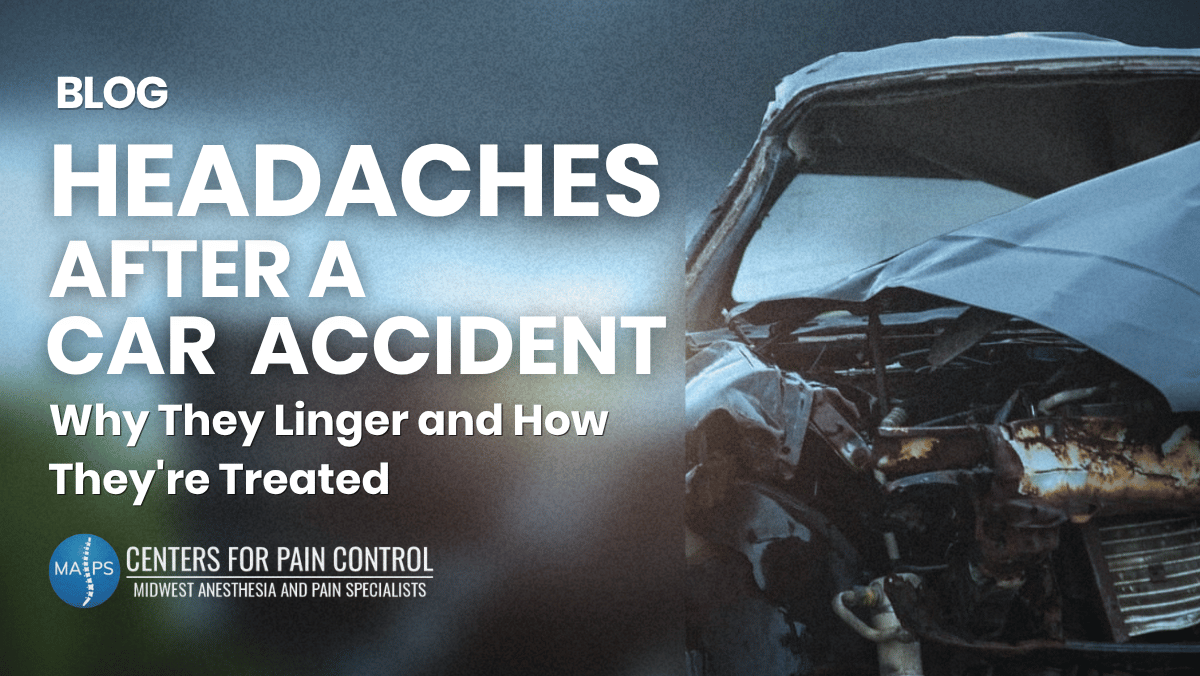
Summary: Headaches are one of the most common symptoms following a car accident, and they frequently outlast the timeline patients expect. The usual reason is that the injury is in the neck rather than the head: whiplash strains the cervical spine, joints, and nerves that refer pain upward. Post-accident headaches also commonly appear with completely normal imaging, which is why they get dismissed even when the pain is very real. Treating them means evaluating the neck as the likely source, and at MAPS, that’s handled through our car accident injury treatment and interventional pain programs.
If you were in a collision weeks or months ago and you’re still getting headaches, you may have started wondering whether you should just be over it by now. You shouldn’t necessarily. Post-traumatic headaches can persist well past the point when the rest of your injuries have settled, and there’s a specific anatomical reason for that. Here’s what’s likely happening and what can actually be done about it.
Why Headaches Are So Common After a Collision
What Whiplash Does to the Cervical Spine and Surrounding Nerves
In a collision, the head snaps rapidly forward and back while the torso is held in place by a seatbelt. That motion strains the muscles, ligaments, discs, and facet joints of the cervical spine, and it can irritate the nerves running through that region, including the occipital nerves that travel up the back of the head.
This matters because those cervical structures refer pain into the head. The injury is in your neck, but you experience it as a headache, which is exactly why patients so often describe head pain without connecting it to a neck injury they may not even feel much of.
Why Symptoms Can Take Days to Appear
Adrenaline and acute stress at the scene of an accident mask pain, and inflammation in injured tissue builds over the following 24 to 72 hours. It’s common for patients to feel relatively fine immediately afterward and considerably worse two or three days later. A delayed onset doesn’t mean the headache is unrelated to the accident.
The Types of Headaches That Follow an Accident
Cervicogenic Headache From Neck Injury
The most common post-accident pattern. Pain typically starts at the base of the skull or in the neck and radiates forward, often staying on one side. It tends to worsen with certain neck positions or movements, and range of motion is frequently reduced.
Post-Traumatic Headache and Migraine-Like Patterns
Some patients develop headaches after a collision that present much like migraine, throbbing, one-sided, with light and sound sensitivity, even without a prior migraine history. In patients who already had migraines, an accident can substantially increase their frequency and severity.
Occipital Nerve Irritation
When the occipital nerves are directly irritated by the injury, the result is sharp, shooting, or electric pain running from the base of the skull up the back of the head, sometimes with scalp tenderness or numbness.
Why Post-Accident Headaches Get Dismissed
Normal Imaging With Real, Ongoing Pain
This is the frustrating part for a lot of patients. X-rays and CT scans after an accident are excellent at identifying fractures and serious structural injury, and they’re often completely normal, which is genuinely good news. But they don’t visualize the soft tissue strain, joint irritation, and nerve involvement that actually cause most post-accident headaches. Normal imaging means nothing is broken. It doesn’t mean nothing is wrong.
Why “Wait and See” Can Let Pain Become Chronic
Many post-accident headaches do resolve on their own within a few weeks. When they don’t, waiting longer tends not to help. Persistent pain signaling can lead the nervous system to become sensitized over time, a process that makes pain progressively harder to treat the longer it continues. If your headaches haven’t improved within several weeks of a collision, that’s the point to have them evaluated rather than continuing to wait it out.
How These Headaches Are Diagnosed and Treated
Evaluating the Neck as the Source, Not Just the Head
An effective evaluation examines the cervical spine directly: which neck movements reproduce your headache, whether specific segments are tender or restricted, whether the occipital nerves are sensitive to pressure, and whether there’s any neurological involvement in the arms. Diagnostic injections can confirm a suspected source by numbing one structure and observing whether the headache resolves.
Interventional Options Including Nerve Blocks and Joint Injections
Because these headaches usually originate from identifiable cervical structures, they respond well to targeted interventional treatment. Occipital nerve blocks address nerve irritation directly. Cervical facet joint injections or medial branch blocks treat joint-mediated pain. Trigger point injections address persistent muscular contributors. For patients with confirmed facet involvement that keeps returning, radiofrequency ablation can extend relief considerably.
These approaches are non-opioid and typically paired with physical therapy to restore the neck’s strength and range of motion, addressing both the pain and the injury underneath it.
Documentation for Insurance and Injury Claims
There’s a practical dimension to post-accident care that’s worth understanding. Proper medical documentation, a clear diagnosis, records of your symptoms and their onset, and a documented treatment course, matters for insurance claims and personal injury cases. Gaps in treatment or long delays before seeking care are commonly used to dispute whether an injury was accident-related.
That’s not a reason to pursue treatment you don’t need. It is a reason to get evaluated promptly and follow through consistently if you are in pain. MAPS regularly works with patients navigating personal injury claims and provides the thorough documentation these situations require. For questions specific to your claim or legal options, that’s a conversation for your attorney or insurer rather than your physician.
Get Evaluated After an Accident at MAPS
If headaches have stuck around after a collision, they deserve a real evaluation rather than more waiting, and the neck is where that evaluation should start. Our double board-certified, fellowship-trained physicians treat post-traumatic headache and neck injury regularly, with a focus on identifying the actual source and treating it without opioids. Schedule a consultation with MAPS Centers for Pain Control at any of our 8 Chicagoland locations.